The Story
Our Current Journey and Vision
For about a decade starting in 1990, we focused our efforts on crafting "authentic sake for everyday life." This commitment resonated deeply with our supporters, allowing us to grow to the full capacity of our facilities while maintaining strict quality standards. From 2000 onwards, our total production—including Junmai sake for liqueurs and international exports—remained stable for over ten years.
As the appreciation for authentic Japanese sake underwent a domestic revival and global interest in Japanese culinary culture surged, we saw a growing demand for premium categories, particularly Junmai Ginjo and above. In response, we began expanding our production capacity in the 2010s while continuously upgrading our facilities to compete at a national excellence level.
Today, over 95% of our production is dedicated to Junmai brewing. We remain a Junmai-focused brewery at heart, with over 60% of our shipments staying within Wakayama Prefecture—a testament to our deep roots and recognition within our local community.
Our brewing water is a moderately "hard water," which provides a robust fermentation power. This results in a flavor profile that is expansive yet soft, characterized by a rich umami and a satisfying presence on the palate. While we continuously strive to secure premium rice, refine our craftsmen's techniques, and advance our technology, our fundamental philosophy remains unchanged: to brew in harmony with our terroir and to cherish the unique individuality of our brewery.
The Sake
From Ancient Poetry to Artisanal Heritage
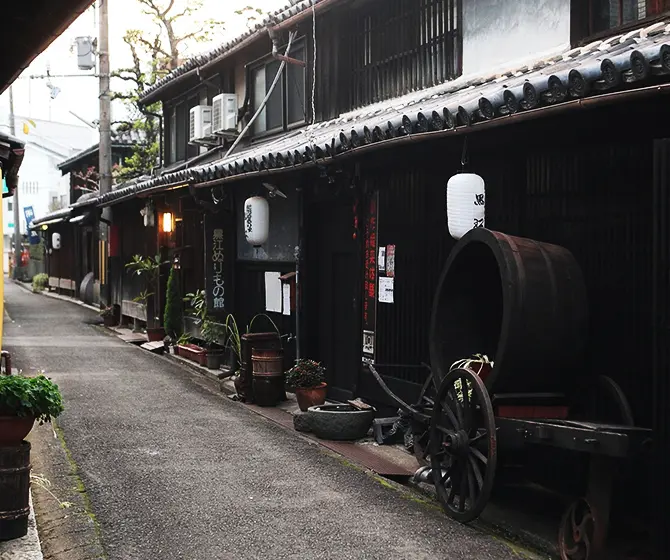
Kuroe, located in Kainan City about 10 kilometers south of Wakayama City, has flourished as a renowned lacquerware production center since the Muromachi period—a true city of artisans. Once a secluded inlet, this scenic area was immortalized in the Man'yoshu (Japan's oldest poetry collection) as "Kuroushigata" (Black Bull Lagoon). Legend has it that a large rock shaped like a black bull once rested on the beach near the brewery. Over time, following seismic uplifts and land reclamation, the urban district of Kuroe—deriving its name from this "Black Bull"—was formed.
The Sake
Traditional Brewing Method
In 1866 (Keio 2), the founder, Me-te Genbei, established his brewing business, catering to the then-thriving community of lacquerware craftsmen. Originally from a farming family in Yasuhara Village, Genbei apprenticed at a fertilizer merchant (Me-te-ya), where his talent was recognized, eventually earning him the right to start his own branch. His journey was not without hardship; a failed venture into candle-making once left him impoverished, forced to live in a back alley so narrow one could not even open an umbrella. However, after returning to his master’s house to refine his skills, he secured a loan of 200 ryo to purchase an Edo-period brewery nearby. This second attempt was a resounding success, marking the legendary beginning of the brewery as it stands today.
From Nashide Shuzo
This message is displayed because you did not provided both a filter and a template to use.