The Story
Sake and Zenji
In the rural outskirts of northern Gifu City, where lush fields stretch wide and a tributary of the Nagara River flows, our brewery was founded in 1835. We were not a brewery born of wealthy landowners; rather, we were a "merchant-style" brewery, purchasing rice from landowners to craft our sake.In the 1960s (Showa 40s), Zenji Shiraki, the sixth-generation successor, took over the family business at a young age.
Back then, locals drinking local sake for their nightly meal was the norm. Beer and wine were rare, and local sake sold effortlessly.
However, as televisions became a staple in households, commercials from major national manufacturers began to flood the airwaves. Once big-brand bottles started lining the shelves of local liquor stores, the once-popular local sake began to lose its ground.
"At this rate, a small brewery like ours won't survive."
With this realization, Zenji began searching for a way to differentiate the brewery.
Then, quite by chance, he discovered a forgotten 1.8-liter bottle tucked away in a dusty corner of the cellar. It had likely been sitting there for four or five years.
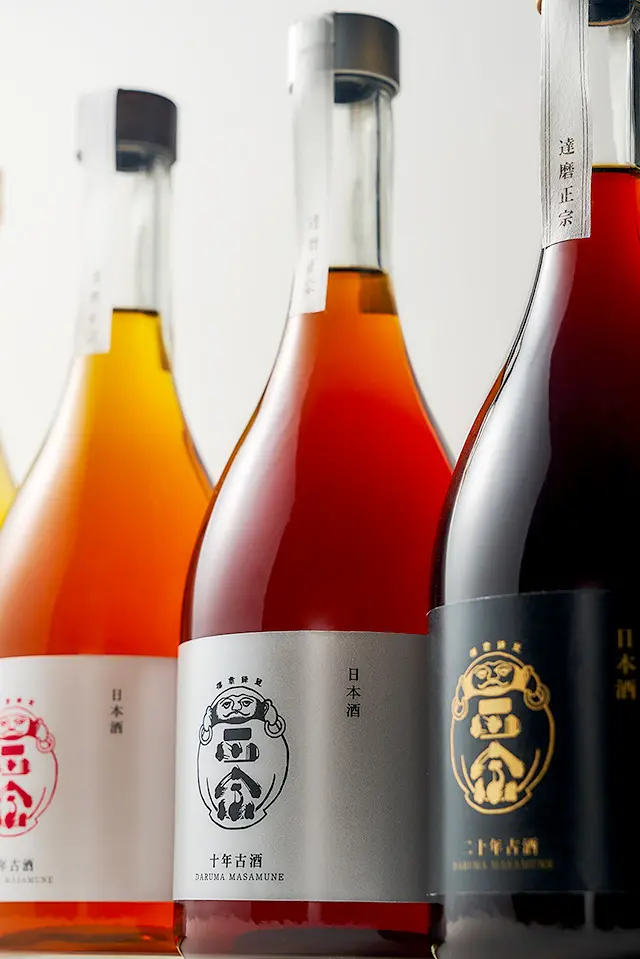
Apprehensively, he broke the seal. What greeted him was a beautiful, shimmering golden hue.
Upon tasting it, he found a profile entirely different—deeper and more complex—than any sake meant to be consumed within a year.
From the very next day, a journey of tireless trial and error began.
The Sake
The Challenge of Revival
What kind of sake must be brewed to eventually transform into a "Koshu" (aged sake) with profound depth and flavor?
I searched through historical records, but found they remained silent on the specifics of the brewing process. The "how" was lost to time.
There was only one way forward: to embrace the laborious task of experimenting with various brewing methods each year, and then verify the results over the course of many, many years.
The challenge to revive the art of aged sake began in 1971.
"This year, let's craft a sweet Junmai-shu."
"Next year, let's try a dry Ginjo-shu."Every year, several types of sake were brewed, yet remained unreleased, tucked away to mature in silence. Thus began a patient, long-term journey of brewing, where the results would only be revealed five or ten years down the road.
For aged sake is something that, in the end, is nurtured by time itself.
The Sake
The Revival of Koshu
At last, the number of people who appreciated our vision grew steadily.
The president of a local bank, the world-renowned sommelier Shinya Tasaki, and insightful buyers from major department stores—one by one, they began to recognize the profound value of "Koshu" (aged sake), nurtured slowly and deliberately over time.
Our long-standing efforts finally culminated in a prestigious achievement: being featured on the JAL International First Class drink menu. What was initially intended to be a standard 3-month placement received such overwhelming praise that it was extended for an unprecedented 3 years.
Today, our reputation is firmly established; to speak of aged sake is to speak of Daruma Masamune.
Moving forward, we will continue to protect the deep, complex flavors that only time and Daruma Masamune can create, while never ceasing to evolve for the future.
From Shiraki Shuzo
This message is displayed because you did not provided both a filter and a template to use.