The Story
Why Captivated by Yamahai and Kimoto
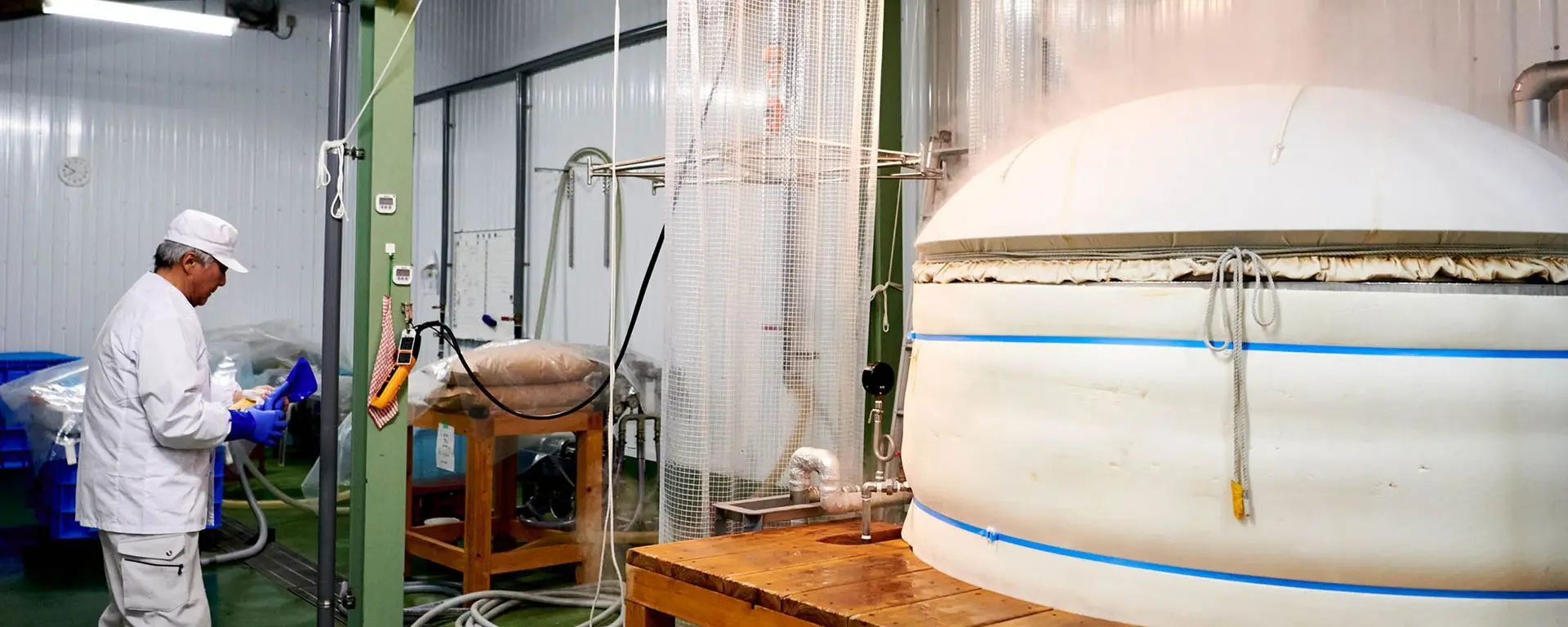
One of the primary reasons I am so captivated by Yamahai and Kimoto is the "microbial succession" that occurs within the yeast starter (shobo)—a natural phenomenon entirely absent in the modern Sokujo (quick-start) method.
In Sokujo-moto, lactic acid is added manually at the initial stage, meaning the yeast is the only active player in the starter. In contrast, Yamahai and Kimoto involve a masterful relay where essential microbes—such as nitrate-reducing bacteria and lactic acid bacteria—emerge at precisely the right moments, passing the baton to one another in a seamless cycle.
By cultivating robust Koji and increasing the sugar concentration of the shobo, we leverage the high natural acidity from lactic acid bacteria and the protective shield of nitrate-reducing bacteria. This "Triple Barrier" allows the yeast to be nurtured in its purest and strongest form, completely shielded from outside contamination.
Sake brewed this way achieves a rare harmony of profound Umami and crystalline clarity, possessing a depth of flavor that withstands and flourishes through aging. This is the exact philosophy of brewing that aligns with the ideal sake we strive to create.
The Sake
The Tradition of Live-in Brewing
Since ancient times, Kurabito (brewers) lived together within the walls of the brewery during the season. We continue this legacy, spending five to six months living and eating together—often spending more time with one another than with our own families.
We do this because the peace of mind that comes from "being able to check the brew the moment a worry arises" is irreplaceable. In the silence of the night, the state of the Koji, the vitality of the Shobo, and the delicate crackle of the fermenting Moromi are packed with data. We sharpen our five senses to their limit—and sometimes rely on a "sixth sense"—to catch and respond to the signals from the microbes. Being on-site allows us to synchronize with the fermentation process, and surprisingly, it is less taxing on the body than commuting back and forth.
Brewing as Teamwork: The Power of a Shared Meal
By sharing three meals a day, we learn the hearts of our colleagues—their passions, their distastes, and their visions. Sake brewing is impossible without impeccable teamwork. Understanding one another, supporting each other, and walking together toward the singular goal of "crafting exceptional sake" is the foundation of everything we do.
The Sake
The History of Yoshimura Hideo Shoten
Since the mid-Edo period, the Wakayama Highway (Yamato Highway) running along the Kino River has been home to a flourishing sake brewing culture. In 1915 (Taisho 4), Yoshimura Hideo Shoten was founded by the youngest son of a family historically rooted in the raw silk industry, marking the beginning of our journey as a dedicated sake brewery.
The Kino River traces its origins to the pristine heights of Odaigahara in the Yoshino-Kumano National Park. It flows through Nara as the Yoshino River before reaching Wakayama as the Kino River. This bountiful water has nurtured the local history and culture for centuries and remains the ultimate treasure for our craft. We brew our sake using the sub-surface water (Fukuryusui) of the Kino River, drawing on the purity of nature to define the soul of our sake.
From Yoshimura Hideo Shoten
This message is displayed because you did not provided both a filter and a template to use.